

Zirconia Crown Problems: Causes, Solutions & Care Guide
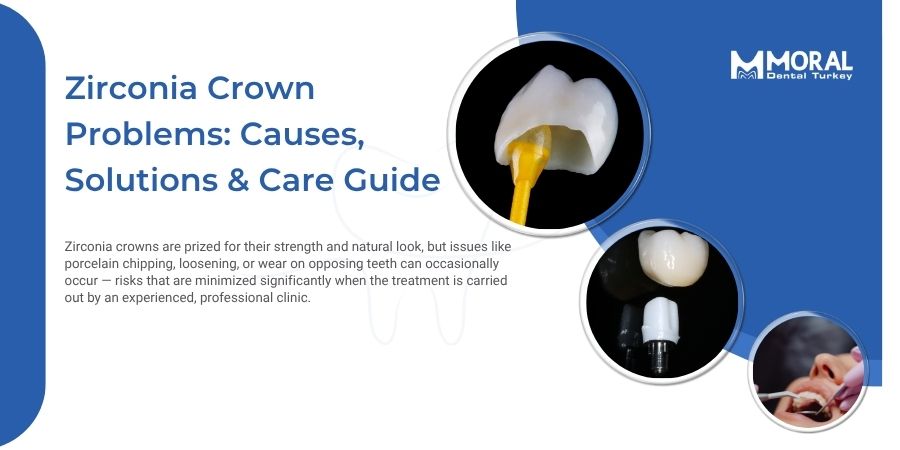
Although zirconia dental crowns are referred to as 'ceramic steel' in dentistry due to their durability and aesthetic appearance, like any dental restoration, they can occasionally present certain problems.
Porcelain chipping and cracks
The most common technical issue with zirconia crowns is the chipping or cracking of the overlying aesthetic porcelain layer into small pieces.
- Causes: This can be caused by thermal incompatibility between the zirconia substructure and the overlying porcelain or by excessive loading on the porcelain layer due to chewing forces.
- Statistics: Some studies have reported that the rate of porcelain chipping in porcelain-fused-to-zirconia (PFZ) crowns can reach up to 50 percent within two years. However, as there is no porcelain layer in new-generation monolithic zirconia restorations, this risk is virtually eliminated.
Detachment of the crown (falling off/debonding)
The loss of retention of zirconia crowns may be slightly higher than that of traditional metal-porcelain crowns.
- Causes: Due to the chemical structure of zirconia, it is difficult to bond it to the tooth using traditional adhesives. Furthermore, excessive shortening of the tooth or incorrect preparation techniques reduce retention.
- Solution: The use of specialized adhesives containing MDP monomer creates a much stronger bond between the zirconia and the tooth, thereby preventing the crown from coming loose.
Wear on opposing teeth
As zirconium is a very hard material, there are concerns that it may wear down the natural teeth in the opposing jaw, much like sandpaper.
Research has shown that well-polished zirconia is gentler on natural tooth enamel than unpolished or merely glazed porcelain. Unpolished, rough surfaces can cause significant wear on opposing teeth and may even lead to enamel cracks.
Secondary Caries and Gum problems
Zirconia itself does not decay, but the natural tooth structure beneath the crown is at risk.
- Causes: If the fit between the crown and the tooth (margin) is not precise, food debris may accumulate, leading to caries forming beneath the crown or gum recession.
- Biological Risks: Inadequate oral hygiene can cause gum bleeding (bleeding on probing) and infection around the crown.
Risk factors related to location and force
The location of the restoration in the mouth directly affects the likelihood of problems arising:
- Molars: As this is the area where chewing force is highest, the risk of fracture and failure in restorations on molars is six times higher than on premolars (small molars).
- Upper Jaw (Maxilla): It has been observed that crowns in the upper jaw carry a higher risk of complications than those in the lower jaw.
What can be done to prevent problems?
Dentist’s Experience: Careful preparation of the tooth and ensuring a millimeter-precise fit between the crown and the tooth using digital scanners (CAD/CAM) can reduce the risk of failure by up to 30 percent.
Use of a Night Guard: If you have a habit of clenching or grinding your teeth (bruxism), this can cause the crown to wear out prematurely or break. You must use a night guard.
Choosing Monolithic Zirconia: Particularly for back teeth, monolithic zirconia (which offers the highest fracture resistance) should be preferred.
Regular Care: Brushing 2–3 times a day, flossing at least once a day, and having a check-up with your dentist every six months can extend the lifespan of your crowns to over 15 years.
F.A.Q:
What is the lifespan of zirconia crowns?
The average lifespan of zirconia crowns is generally between 10 and 15 years. However, with excellent oral hygiene and regular check-ups, this can extend to several decades.
What is the most common technical problem?
The most common problem is the aesthetic porcelain layer on the zirconium substructure chipping off in small pieces or cracking; this is known as 'chipping.'
Do zirconium crowns wear down the teeth in the opposing jaw?
Zirconium is a very hard material. If the surface has not been properly polished, it can wear down the natural enamel of the opposing teeth, much like sandpaper.
Can decay form under the crown?
Zirconia itself does not decay; however, if there is leakage at the margins where the crown meets the tooth, or if oral hygiene is inadequate, secondary decay may develop in the underlying natural tooth structure.
Does the veneer need to be replaced if the porcelain chips?
If the chipped piece is small and does not affect the aesthetics, the dentist may polish it (Grade 1) or repair it with a composite filling (Grade 2), allowing it to remain in use. However, replacement is necessary in the case of large fractures.
What is monolithic zirconia, and does it cause fewer problems?
Monolithic zirconia is a crown produced from a single block and does not have a porcelain layer on its surface. As there is no porcelain, there is no risk of porcelain chipping, and it is much more durable.
Does teeth grinding (bruxism) damage zirconia?
Yes, uncontrolled chewing forces can cause cracks in zirconia. Patients experiencing this problem must use a night guard to protect their crowns.
What are the consequences of an incorrect bite adjustment?
If the crown is slightly higher than the other teeth, it will bear an excessive load during chewing. This can cause the crown to fracture, become loose, or result in pain in the underlying tooth.
Are there more problems with zirconia crowns on implants?
Some studies suggest that, as implants lack the flexibility (shock-absorbing property) of natural teeth, the risk of porcelain chipping may be slightly higher with crowns on implants.
Can zirconia crowns break completely?
Although rare, fracture of the substructure may occur, particularly in molars where the chewing load is very high and the zirconia thickness is kept very thin (less than 0.5 mm).
Does zirconium cause allergies?
One of the greatest advantages of zirconium is its high biocompatibility. As it contains no metal, the risk of tissue irritation or allergic reactions is negligible.
In which area of the mouth are teeth more likely to develop problems?
As the molars in the back of the mouth are subjected to much greater chewing forces than the front teeth, the risk of problems arising with crowns in this area is six times higher.
Does gum recession cause aesthetic problems with zirconium?
As the zirconia framework is white, even if the gums recede, a dark or purple line will not be visible, as is the case with metal-supported crowns. However, the exposed root surface is susceptible to decay.
What causes discoloration at the edges of a crown?
Discoloration observed at the edges of a crown over time is usually caused by food debris resulting from poor oral hygiene or the crown not fitting the tooth properly (marginal defect).
Does eating hard foods damage zirconia?
Zirconia is very strong, but chewing ice, cracking nut shells, or using the crown as a tool (such as opening a bottle cap) can break even 'ceramic steel'.
If my crown comes loose, can it be re-cemented?
If the crown itself and the underlying natural tooth structure are sound, it can be cleaned and re-cemented by your dentist.