

Tips to Deal With a Loose Dental Crown
Dental crowns are an excellent solution for protecting, strengthening, and enhancing the appearance of our teeth. However, they can sometimes become loose or come out of place for various reasons. Whilst this rarely constitutes a medical emergency, it can be quite frustrating, particularly if it affects the front teeth. If you find yourself with a loose dental crown, here is what you need to know and do:
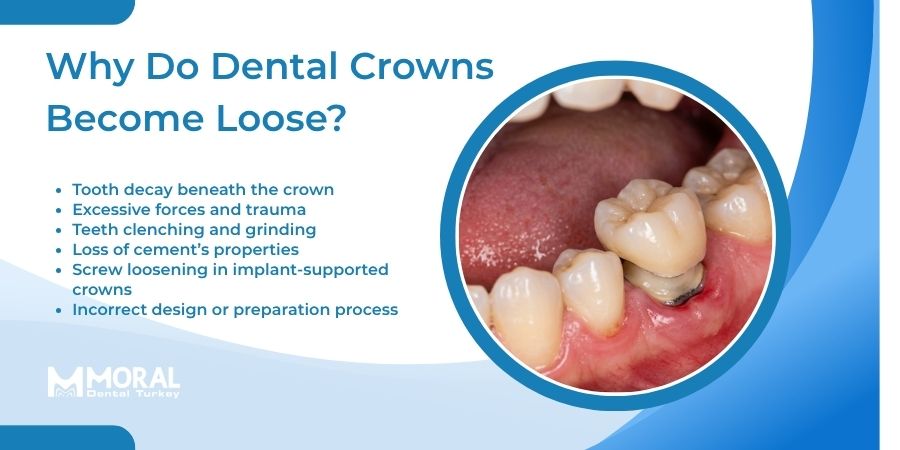
Why do dental crowns become loose?
There are many possible reasons why your crown might become loose. If you notice this happening, it is best to consult your dentist without delay to protect the tooth underneath and prevent more serious infections. Common causes of loose dental crowns include:
Tooth decay beneath the crown
As crowns are made of porcelain or metal alloys, they do not decay; however, the natural tooth structure beneath them remains vulnerable to decay. If areas around the edges of the crown cannot be cleaned properly, bacterial plaque accumulates there and may lead to gum recession. When the gums recede, the neck of the tooth is exposed and the tooth structure beneath the crown begins to decay. As the tooth structure decays, the foundation to which the crown is attached weakens, and as a result, the crown becomes loose or falls out completely.
Excessive forces and trauma
Dental crowns are quite strong but are not indestructible or unshakeable. Sudden and powerful forces, such as biting down on something very hard, can dislodge the crown. Furthermore, trauma such as a fall or impact can weaken the bond of the crown, causing it to become loose.
Teeth clenching and grinding (Parafunctional habits)
Many of us unconsciously clench or grind our teeth at night (bruxism). This creates constant pressure inside the mouth. Such habits can exceed normal limits by increasing the chewing forces (occlusal forces) acting on the crown, potentially damaging the crown’s adhesive (cement) or dislodging the crown itself.
Loss of Cement’s Properties
Crowns are fixed to the tooth by dentists using special dental cements. Over time, particularly if the crown does not fit perfectly or if there are microscopic leaks, this cement may dissolve or weaken upon contact with saliva and oral fluids. When the crown comes loose, the remnants of the old adhesive left inside serve as an indication of how the bond broke over time.
Screw loosening in implant-supported crowns
If your crown is mounted on a dental implant, the situation may be slightly different. Implant crowns are usually secured using a screw mechanism. The clamping force created by tightening this screw holds the crown in place. However, chewing forces can cause this screw to loosen over time. If your implant crown is wobbly, this is usually due to the screw inside loosening or the mechanism holding the screw failing.
Incorrect design or preparation process
Sometimes, the reason for the crown becoming loose can be traced back to the initial preparation stage. If the tooth has not been prepared to provide sufficient support for the crown, or if the crown’s design distributes chewing forces incorrectly, the crown may not be long-lasting. Furthermore, temporary crowns that do not fit properly or the use of insufficient material can also affect the fit of the final crown, potentially leading to loosening in the future.
What to do if your dental crown comes loose
In such a situation, it is important to stay calm and follow the steps below until you can contact your dentist:
Contact your dentist immediately
The first thing you should do is contact your dentist without delay. It is important not to delay treatment unnecessarily, as this is crucial for protecting the tooth underneath. If your crown was fitted in a hospital or clinic setting, you may need to be referred to your own dentist or the relevant department.
Prepare the crown and tooth
If the crown has come off completely, keep it in a safe place and follow these steps:
- Cleaning: Gently clean the inside of the crown to remove as much of the old adhesive (cement) residue as possible.
- Check: Place the cleaned crown onto your tooth to check whether it sits normally and correctly in your mouth.
- Drying: Before fitting the crown onto the tooth, thoroughly dry both the inside of the crown and the tooth in your mouth using a cotton swab or a clean tissue.
Temporary fixation (First aid)
Here are some ways to keep the crown in place until you can see a dentist:
- Temporary dental cement: You can buy "dental first aid kits" from pharmacies that already have everything you need. Follow the manufacturer's directions to mix a tiny amount of cement. Then, coat the inside of the crown and place it correctly over the tooth. When you bite down, everything should feel normal.
- Options: If you can't obtain a kit, try to hold the crown in place for a short time by putting a thin layer of Vaseline or denture glue on the inside.
- Pain management: If your tooth is sensitive or hurts, putting these temporary cements on the exposed surface of the tooth may help. You can also take the painkillers you usually take.
Help from a professional
Your dentist will look at the crown and the tooth underneath it during your appointment. Your dentist can clean and sterilize the crown before putting it back on permanently if it is still in excellent shape and fits the tooth correctly.
Steps to keep your dental crown from coming loose or falling out:
It's critical to keep your dental crown from getting loose or falling out so that both the crown and the natural tooth underneath it stay healthy. To make your crown last longer and stay in place, follow these steps:
Make sure your mouth is always clean.
Dental crowns don't rot; however, the natural tooth structure behind them can still decay.
- Cleaning the margins: The margins, or the places where the crown meets the gum, are where bacteria are most likely to grow. If plaque builds up in these regions and isn't cleaned out properly, it might cause gum recession. When the gums pull back, the root of the tooth is exposed, and the tooth under the crown starts to rot. This weakens the base that the crown is attached to, making it loose.
- Brushing and flossing every day: Just like normal teeth, crowns should be brushed at least twice a day. To keep the regions between your teeth from getting cavities, you need to use dental floss.
- Special equipment: To clean the areas under bridges or multiple crowns, you should use special cleaning instruments like "superfloss" or floss holders.
Be mindful of chewing forces
Although crowns are strong and durable restorations, they can be dislodged by excessive force.
- Hard and sticky foods: It is essential to avoid hard or sticky foods, particularly during the temporary crown phase; however, for permanent crowns too, excessively forceful foods (such as cracking nut shells or chewing ice) can cause the bonding cement to fail.
- Managing habits: Habits such as teeth grinding (bruxism), clenching, or tongue thrusting create constant and damaging pressure on crowns. This can particularly cause the screw or crown to loosen in implant-supported crowns. Protective measures, such as the use of a night guard, may be recommended by your dentist to manage these forces.
Regular dental check-ups
Regular clinical check-ups and appointments with a dental hygienist are essential for the longevity of your crowns.
- Early detection: During routine check-ups, your dentist can identify issues such as poor fit, marginal leaks, or micro-loosening before you even notice them.
- Professional care: Scaling and gum care help keep the tissues supporting the crown healthy, thereby reducing the risk of the crown becoming loose.
Special precautions for implant-supported crowns
If your crown is on an implant, extra care is required depending on whether it is screw-retained or cemented:
- Force balance: With implant-supported crowns, chewing forces must be directed vertically (axially). As lateral (sideways) forces can cause the screw to loosen, the occlusal (bite) adjustments made by your dentist are critical.
- Passive fit: The contact between the crown and the adjacent teeth must be neither too tight nor too loose; a correctly adjusted contact prevents the restoration from being exposed to lateral forces that could loosen the screw
F.A.Q:
Is a loose dental crown an emergency?
No, it is not usually an emergency, but you should see a dentist as soon as possible to prevent the crown from falling out completely or becoming damaged while chewing.
Does a loose crown cause pain?
It usually does not cause pain, but if there is decay or nerve damage in the tooth underneath, mild to moderate pain may occur.
Should I remove the loose crown myself?
No, do not force it. If the crown is already loose, you can remove it carefully, but never use pliers or hard tools.
If the crown falls out, will the natural tooth underneath become sensitive?
Yes, sensitivity to hot, cold, or air is normal. You can temporarily use dental adhesive or fluoride gel.
What should I do if food gets trapped under a loose crown?
Gently rinse with warm salt water or try cleaning with dental floss. Food debris can lead to decay and infection.
Can I eat with a loose crown?
If possible, avoid chewing on the side where the crown is. Avoid sticky, hard, or difficult-to-chew foods.
How long can a loose crown stay in place?
Temporary adhesives usually last 1–3 days. You should see a dentist within a week at the latest.
Does toothpaste work to temporarily secure the crown?
It may be a very short-term (a few hours) solution, but it is not as effective as an adhesive, and the paste may dissolve.
How can I tell if there is a cavity under a loose crown?
If there is a bad taste, odor, black spots, or a feeling of softness in the tooth, there may be a cavity. The dentist will diagnose this using an X-ray
Should I use dental floss with a loose crown?
Yes, but be very gentle. Use the floss by pulling it sideways to clean the plaque around the crown.
What should I do if the crown falls out and gets lost?
Don’t panic. Your dentist can make a new crown. However, if you find it, clean it and keep it safe.
Does a loose crown cause bad breath?
Yes, food particles and bacterial build-up underneath can lead to a bad smell. A saltwater rinse can help temporarily.
Can I sleep with a loose crown?
Yes, but if you clench or grind your teeth at night, it may be safer to remove the crown.
Should I remove the crown before my dental appointment?
If the crown is very loose and at high risk of falling out, you can clean it and bring it in a container. Otherwise, leave it in place.
Can a loose crown lead to infection?
If left untreated for a long time, decay or gum inflammation may develop underneath it. This can lead to an abscess.
H-3. What should I do if my implant-supported crown becomes loose?
If your loose crown is on an implant, the problem is usually caused by the screw securing the crown to the implant becoming loose. In this case, you should not attempt to fix it yourself; your dentist will need to retighten the screw using a special torque wrench to apply the correct force.
Can a loose or fallen crown be reattached using household adhesives?
One of the most important rules is never to use superglue or other household adhesives. These products are not safe for use inside the mouth; they can cause serious damage to both your tooth and the crown, rendering treatment impossible.