

My Crown Fell Off and My Tooth is Black: What Should I Do?
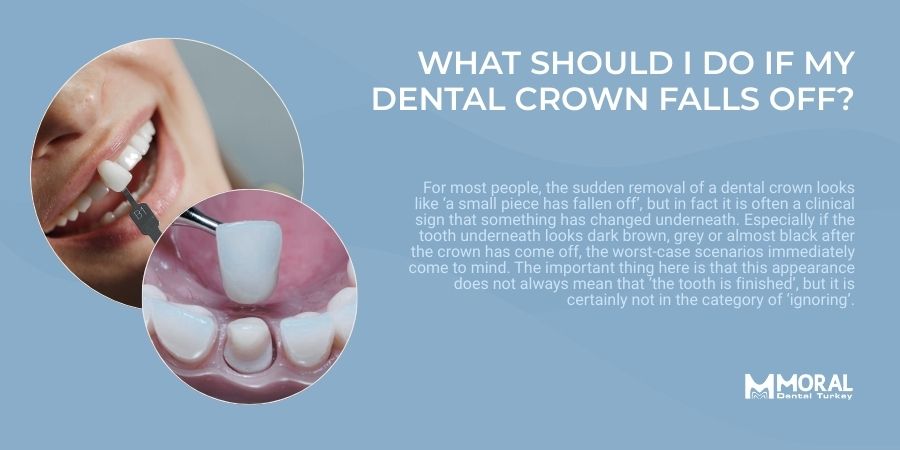
For most people, the sudden removal of a dental crown looks like 'a small piece has fallen off', but in fact it is often a clinical sign that something has changed underneath. Especially if the tooth underneath looks dark brown, grey or almost black after the crown has come off, the worst-case scenarios immediately come to mind. The important thing here is that this appearance does not always mean that 'the tooth is finished', but it is certainly not in the category of 'ignoring'.
Crowns normally serve for many years. In clinical follow-ups, we know that a properly planned crown continues without any problems at a high rate in the 5-year and 10-year band; In the long term, we know that problems such as leakage, decay, fracture, loss of adhesion can be seen in some of them (about 15-30%). In other words, it is not 'impossible' for the coating to fall off; it is evaluated with the approach of 'if it happened, there must be a reason'.
Below, from a physician's point of view, I explain in an understandable language why the crown falls off, why the tooth underneath darkens, what can be done safely at home, which situations are urgent and how the treatment is planned in the clinic.
Why did your crown fall off? (Not just 'the adhesive has weakened')
From the outside, the crown appears to be simply bonded, but in reality it is held in place by two basic things:
(1) the shape of the tooth (mechanical retention) and (2) the cement/adhesive system used (bonding). The better these two work, the more stable the crown will be.
The way the tooth is prepared (preparation) is more critical than you expect
When the crown is made, the tooth is reduced and given a form in which the 'crown will fit'. If the length of this form is too short, if the walls are left too tapered or if the tooth is thinned too much, the solid surface on which the crown will adhere is reduced. In such a case, no matter how good the cement is, chewing forces and micro-movements may loosen the crown over the years. This risk is more pronounced in short teeth, especially in the posterior region.
Leakage at the edge of the crown and caries under the crown
Crowns are not a perfect 'vacuum seal'. When a microscopic opening occurs at the edge (due to reasons such as gingival recession, cement dissolution, deterioration of the edge harmony over time), bacteria can move under the crown. This process is not fast; it is silent. In months or years, the tooth tissue weakens, the crown cannot find a 'tooth to hold on' and at some point it falls off. When the crown falls off, the appearance of softened / blackened tissue inside suggests this scenario.
Dissolution of the cement/adhesive over time or faulty bonding from day one
Some cements (especially older types) are more prone to dissolution over the years. On the other hand, if the crown has been recently applied and falls off in a short time, instead of 'dissolution over time', one often thinks of a problem with the bonding procedure: deterioration of the isolation (saliva contamination), incomplete fit of the crown, incomplete application of the bonding protocol.
Clenching (bruxism) and bite trauma
Nighttime clenching/grinding is like a chronic 'load test' for crowns. Micro-movements increase; leakage starts at the edges; cement gets tired. On top of that, if the crown is high or the bite is misaligned, the crown is subjected to impact with every bite. This accelerates loosening.
Hard and sticky foods and 'using teeth like tools'
Ice, hard candy, nuts, and habits such as opening packets can weaken the ligament system in the long term, even if they do not break the crown in one blow. Some crowns also crack and fall off with these impacts; if the crown has already split in two, the option of re-bonding is usually out of the question.
Why does the tooth under the crown appear black/dark?
This part is the most visually 'alarming'. There are several possible sources of the dark appearance; some are superficial, others are related to the internal biology of the tooth.
Decay under the crown (microbiological cause)
If bacteria have entered under the crown, they progress by breaking down the dentin tissue. Progressive decayed dentin usually appears in a brown-black shade. This is one of the most common causes of the 'blackened underneath' appearance when the crown falls off. In this case, the tooth structure may also have softened.
Loss of tooth vitality (pulp necrosis) and internal discolouration
The pulp (nerve-vascular tissue) inside the tooth can lose its vitality due to trauma, deep decay or prolonged irritation. When the living tissue dies, haemoglobin breakdown products and pigments can leak into the dentinal tubules, resulting in a grey-brown-black discolouration of the tooth. Sometimes the patient does not feel any pain because there is no living tissue. Imagine a discolouration that looks like a bruise from the outside but is stained from the inside. Darkening under the crown can therefore also be seen.
Natural colour of the dentin layer (anatomical reason)
Once the crown has fallen off, the surface you see is often not 'white like enamel', because part of the enamel layer of the tooth has already been abraded for the crown. The lower layer, the dentin, appears more yellow-darker. This can be perceived as 'black', especially due to light reflections and intraoral shadow. In other words, not all darkness is caries, but the way to distinguish it is examination.
Metal substructure/metal post and ion-induced discolouration
In old metal-supported crowns or teeth with metal posts, the colour of the tooth may change to grey over time. In this case, the vitality of the tooth may be normal; the discolouration is more likely due to the material. However, it would not be correct to say 'this is for sure' without seeing what is underneath when the crown falls off.
What can you do at home? (A safe and practical 'damage control' plan)
The goal at this stage is not to 'cure', but to protect the tooth, control the pain and not make the problem worse.
First find the crown and save it. If the crown is not broken, it can be reused in many cases, which is both time and cost effective. Store the crown in a clean container/bag. Do not forcefully scrape off any debris from the inner surface; if there are coarse residues, clean them very gently.
It makes sense to rinse the inside of the mouth with warm salt water. This keeps the area clean and can reduce gum irritation. If sensitivity is present, favour lukewarm to room temperature drinks; too hot/too cold can be a trigger.
It is wise to 'err on the soft side' for a few days. Hard, sticky and sugary foods are risky: hard food can break teeth, sticky food pulls teeth, sugar fuels bacteria. Do not chew on that side; use the other side.
Temporary dental cements available from pharmacies can sometimes last for a few days, but do not see this as a 'solution' but as a 'time-saver'. If you are going to use temporary cement, the inside of the tooth and the crown should be as clean and dry as possible; otherwise, the adhesion is already weak. Moreover, do not forget that temporary cement is a material that is prone to leakage: staying like this for days or weeks can increase the entry of bacteria under the crown.
What you should definitely avoid are industrial adhesives such as super glue. These substances can irritate the oral tissue, leave a permanent residue on the tooth surface and make it difficult for the dentist to treat the tooth correctly.
If the crown is half-moving, the reflex of 'pulling it out myself' is also risky. If the underlying tooth is already weakened, pulling can break off more pieces. If the crown is completely removed, keep it; if it is half removed, go to the dentist, if possible, without moving it at all.
When is it urgent? When is it 'not urgent but not delayed'?
The answer to this question has more to do with the condition of the underlying tooth than with the loss of the crown.
Urgent assessment is required in the following cases:
- Severe, throbbing pain (especially if it increases at night)
- Swelling of the gums/face, pain with pressure, pus discharge or bad taste
- Fever, malaise, diffuse facial swelling
- Suspicion of a significant fracture/crack in the tooth after the crown has fallen off
- Stabbing pain when biting (possibility of cracked tooth)
Even if there is no pain and the tooth is not visible, it is not right to wait for weeks because 'it does not hurt anyway'. Because leakage and decay can progress without causing pain. In the best case scenario, only re-gluing may be sufficient, while in case of delay, filling, canal treatment or new coating may be required.
How is it assessed in the clinic, how is treatment planned?
For the dentist, this is a question of 'why did it fall off?' before 'should we replace the crown?'. The following steps are usually followed in the examination:
First, the crown and tooth are examined: Is the crown broken, are the edges deformed, is there any soft tissue inside, such as caries? Radiographic evaluation is then performed: caries under the crown, root tip infection, tooth vitality and, if necessary, periodontal status (gum-bone level).
After this, the options become clearer:
Re-bonding only
If the tooth tissue is intact, there is no caries, the crown fit is good and the crown is not broken, it can be cleaned and re-cemented.
Caries cleaning + tooth reconstruction + bonding or new crown
If there is caries under the crown, the caries is first cleaned and the tooth is restored to 'carry the crown' (core build-up). The old crown can sometimes be reused, sometimes a new one is required because the harmony is disturbed.
Root canal treatment + crown renewal
If the vitality of the tooth is lost or there is evidence of infected pulp, root canal treatment is planned. Then, depending on the structure of the tooth, the crown can be re-glued or renewed.
Extraction + implant/bridge
Extraction is considered in rare but possible scenarios such as an unsalvageable fracture of the tooth (especially a root fracture) or a very advanced caries. Afterwards, rehabilitation of the cavity with an implant or bridge is planned.
Assessment: This is a 'nasty surprise', but often not unsolvable
The loss of the crown and the dark appearance of the tooth underneath is a situation that can usually be managed with early intervention. What you need to do at home is not treatment, but proper prevention. The critical point is to identify the underlying cause without delay. Because sometimes the same problem is solved with 're-cementation', sometimes it requires 'caries cleaning + strengthening', and sometimes it requires root canal treatment.
Scientific References
- Crown discoloration & pulp necrosis relationship
https://pubmed.ncbi.nlm.nih.gov/32901727/ - Prognosis of crown discoloration in traumatized teeth
https://www.researchgate.net/publication/339305263_Incidence_and_prognosis_of_crown_discoloration_in_traumatized_primary_teeth_A_retrospective_cohort_study - Technical complications and failure of dental crowns
https://pmc.ncbi.nlm.nih.gov/articles/PMC10535933/ - Causes of crown failure and retention loss
https://www.i-jmr.org/2025/1/e57958/PDF - Pulp necrosis and internal tooth discoloration mechanisms
https://www.ncbi.nlm.nih.gov/books/NBK539728/ - Secondary caries and microleakage beneath crowns
https://pubmed.ncbi.nlm.nih.gov/30686714/ - 7. Bruxism as a risk factor for prosthetic complications
https://pubmed.ncbi.nlm.nih.gov/31580720/