

Invisalign vs Braces: Which One Is Right for You?
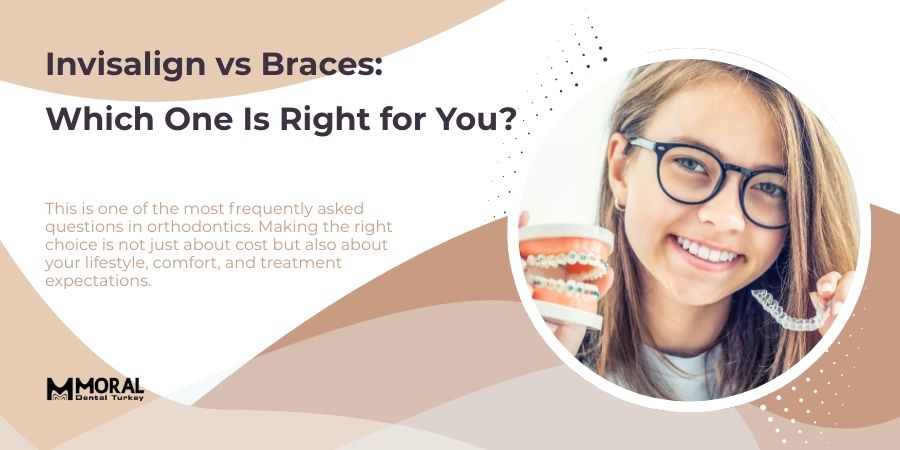
'Invisalign or traditional braces?' This is one of the most frequently asked questions in orthodontics. Making the right choice is not just about cost but also about your lifestyle, comfort, and treatment expectations.
In this article, we will examine both methods in great detail. Our aim is not only to provide you with information but also to ensure you feel confident and informed when discussing your options with your dentist.
Traditional braces (metal braces):
Traditional braces are the 'classic' and longest-used method in orthodontics. Their basic working principle is simple yet effective. This system gradually and carefully moves teeth into their desired position. They are extremely strong and are used in the treatment of almost all types of dental misalignment and malocclusion. Traditional braces include:
Brackets:
These are small, usually metal pieces attached to each tooth with a special adhesive. Ceramic (transparent) brackets are also widely used today.
Archwire:
A metal wire that runs through the brackets and applies constant, gentle pressure to the teeth. This wire is tightened or replaced at regular intervals by the dentist to progress the treatment.
Ligature:
Small rubber bands that connect the wire to the brackets. They can often be colored and have become a style statement, particularly among young people.
Invisalign:
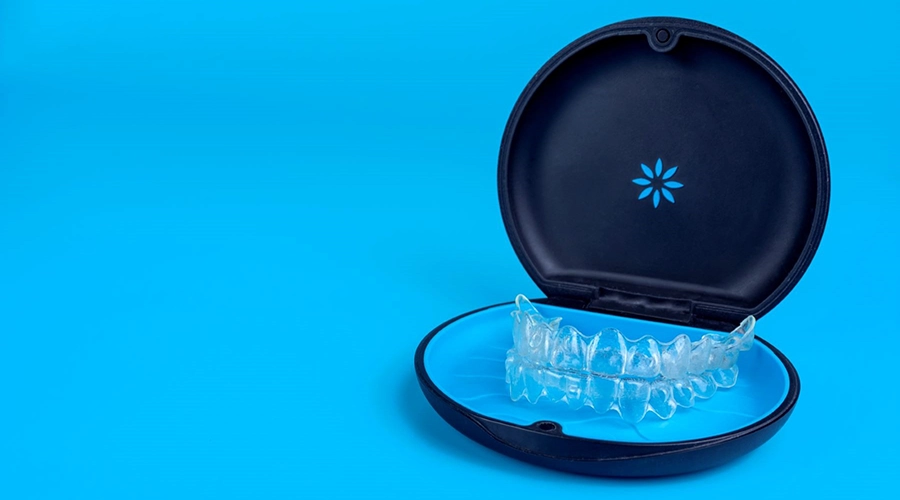
- Invisalign is considered a revolution in orthodontic technology. It uses 3D computer modelling and manufacturing technology.
- At the heart of the clear aligner treatment are custom-made, removable clear aligners. These aligners fit perfectly over your teeth and are virtually invisible.
- Your dentist takes a 3D scan or impression of your mouth. Using this data, a digital treatment plan is created that simulates the entire journey of your teeth from their current position to their ideal final position.
- Based on this digital plan, a series of aligners are produced, each worn for an average of 1-2 weeks and moving the teeth by millimeters. Each new aligner is slightly different from the previous one, so the teeth gradually move towards the target position.
Which method is more suitable for you?
To assist you in your choice, we will compare the two methods under different criteria in the following paragraphs. However, whichever method you choose, there is one very important point you must remember: Retainer Treatment. After treatment, your teeth are prone to shifting back to their original positions (relapse). Therefore, it is very important to regularly use a retainer (usually a clear aligner or a thin wire bonded to the back of the teeth) as recommended by your dentist.
Appearance and aesthetics
Invisalign: Its biggest advantage is that it is virtually invisible. Since the aligners are transparent, they are only noticeable when viewed up close. This is a decisive factor, especially for adults and young people who are sensitive about their appearance. It provides comfort at meetings, in social settings, or in photographs
Braces: Traditional metal brackets are noticeable. However, this is no longer necessarily a disadvantage but can also be a matter of preference. Colored elastics, in particular, are a form of self-expression among young people. Additionally, there is the option of completely hidden brackets called 'lingual brackets,' which are attached to the back surface of the teeth. However, this method can be uncomfortable for the tongue initially and is more expensive. Ceramic braces are less visible on the front teeth, but they still have wires.
Comfort and ease of use
Invisalign:
Removability: The biggest advantage is that you can remove them while eating, drinking, and brushing your teeth. This eliminates dietary restrictions and makes oral hygiene incredibly easy.
Irritation: As there are no sharp edges such as metal wires or brackets, the risk of irritation or injury to the inside of the cheeks and lips is very low.
Adjustment period: When a new plate is fitted, you may feel slight pressure and discomfort for a few days, but this is generally milder than with traditional wires.
Braces:
Fixed structure: Brackets remain in your mouth throughout treatment and cannot be removed. This can cause pain and discomfort, particularly when first fitted and after each tightening, which may last a few days.
Risk of irritation: Brackets and wires may irritate the inside of your cheeks and lips. Your dentist may provide you with a special wax to prevent this.
Emergencies: A broken bracket or a wire that comes loose may require an emergency appointment and cause discomfort.
Oral hygiene and care
Invisalign: It is unquestionably superior in terms of hygiene. You can brush your teeth normally and use dental floss by removing the aligners. This minimizes the risk of tooth decay and gum problems.
Braces: Food particles inevitably get stuck between the brackets and wires. This requires careful and thorough oral care. Special brushes (e.g., interdental brushes) and flossing are essential. Otherwise, there is a high risk of white spot lesions (permanent white marks visible after the wires are removed), cavities, and gum inflammation.
Diet and food restrictions
Invisalign: There are no restrictions. You remove your aligners while eating, so you can comfortably eat hard fruits such as apples and carrots, sticky foods such as popcorn, chewing gum, and caramel, and nuts.
Braces: Certain foods must be avoided completely. Hard foods (nuts, etc.) can break the brackets. Sticky foods (Turkish delight, chewing gum) stick to the wires, causing damage that is difficult to clean. Additionally, instead of eating a whole fruit like an apple, it should be sliced..
Treatment duration and appointment frequency:
Invisalign: Treatment duration is generally shorter than with braces, ranging from 6 to 18 months on average. However, this depends entirely on the patient's compliance. Failure to adhere to the 20-22 hours per day rule will prolong treatment or cause it to stall. Appointments are usually every 6-8 weeks and are shorter.
Braces: Treatment duration typically ranges from 18 months to 3 years and may take longer in complex cases. Appointments are more frequent (usually every 4-6 weeks) and require tightening or changing the wires at each appointment.
Effectiveness:
Invisalign: As technology advances, the range of cases that Invisalign can treat has expanded. It is ideal for mild to moderate crowding, gapped teeth, and some bite issues (e.g., deep bite). However, it may still be limited for very severe crowding, large rotations, or skeletal problems (jaw-related issues). This depends on your dentist's diagnosis.
Braces: They are considered the 'gold standard' for treating almost any type of orthodontic problem. They can control even the most complex tooth movements, rotations, and jaw positioning. Braces are preferred, especially in children and adolescents, when growth and development need to be guided.
Cost
In general, Invisalign treatment is comparable to traditional braces or may be slightly more expensive. However, the price varies depending on the complexity of the treatment, its duration, and your dentist's experience.
Ceramic braces are generally more expensive than metal braces. Lingual (inside-mounted) braces are usually the most expensive option. The cost of Invisalign also varies depending on the number of aligners used and the complexity of the treatment plan. Remember, the cost should be calculated considering not only the initial price but also possible emergencies (such as repairing a broken brace) and maintenance products.
Patient compliance:
Invisalign: The most challenging aspect of this method is patient discipline. The aligners must be worn for 20-22 hours a day. Forgetfulness or the constant urge to remove and reinsert them can lead to treatment failure. Additionally, the aligners must be cleaned regularly.
Braces: Patient compliance is more passive here. Since the brackets are fixed in your mouth, there is no such thing as 'forgetting to wear them.' The patient is only responsible for adhering to oral hygiene and dietary rules.
Who should choose which option? Recommendations.
Traditional braces may be a better choice for you in the following situations. If:
- You have a very complex or serious problem with your teeth and jaw structure.
- You are a child or teenager still growing, and your jaw needs to be guided.
- Cost is the most important factor for you, and you are looking for a more economical option.
- You do not feel confident about wearing a removable appliance and think you might forget to put it in.
Invisalign may be a better choice for you in the following situations. If:
- You are an adult and wish your treatment to remain as discreet as possible for professional or social reasons.
- You place great importance on oral hygiene and do not wish to deal with brackets.
- You play sports (brackets can increase the risk of injury).
- You are a musician (especially if you play a wind instrument).
- You do not want to adhere to dietary restrictions.
- You are disciplined and believe you can comply with the rule of wearing the aligners for 20-22 hours a day.
- You have a mild to moderate orthodontic problem.
Invisalign vs Braces: Compare comfort, cost, treatment time and results. Learn which orthodontic option is best for your smile with our expert guide.
Invisalign or braces? Who will decide?
Invisalign or braces? There is no single, definitive answer to this question. The correct answer depends on your mouth structure, lifestyle, budget, and personal preferences.
This article can serve as a guide, but you should never make the final decision on your own. The best thing to do is to consult an experienced orthodontist and undergo a comprehensive examination. Your dentist will assess your situation and explain in detail which method is more suitable, effective, and efficient for you. Therefore, you should make your decision based on your dentist's advice.
Whichever path you choose, the healthy, straight, and beautiful smile you will achieve in the end will be worth all the challenges you face along the way. This is one of the most valuable investments you can make in yourself.
F.A.Q.
Will I feel pain or discomfort during treatment?
Some discomfort is normal with both methods as the teeth are moving.
Invisalign: When each new aligner is fitted, mild pressure and discomfort may be felt for the first 1-2 days.
Braces: More pronounced pain may occur for a few days after brace tightening appointments. Pain may also occur due to the brackets and wires irritating the soft tissue.
Which one gives faster results?
Traditional braces are generally slightly faster. However, the difference is not significant and again depends on your case.
Braces: As they are fixed to the teeth, movement continues 24/7. They can shorten the duration in complex cases.
Invisalign: The success of the treatment depends on wearing the aligners for 20-22 hours a day. If the patient does not adhere to this rule, the treatment time will be extended. While an average Invisalign treatment lasts 12-18 months, a similar period with braces may be 18-24 months.
Invisalign vs Braces: Compare comfort, cost, treatment time and results. Learn which orthodontic option is best for your smile with our expert guide.
Which is more comfortable?
The general consensus is that Invisalign is more comfortable.
Invisalign: The edges of the aligners may irritate your gums, but they cause much less discomfort than braces. A slight pressure is felt when each new aligner is fitted, which is a sign that the teeth are moving.
Braces: The wire and brackets can cause sores on the inside of the cheeks, lips, and tongue. Pain and sensitivity in the teeth for a few days after tightening is normal.
Is it difficult to wear Invisalign for 20-22 hours a day?
This is the most challenging and important part of Invisalign treatment. It requires discipline. The aligners must be worn continuously except when eating and drinking (except water). Forgetting or not wearing them prolongs the treatment time and negatively affects the outcome.
What is the difference between lingual (lingually bonded) braces and Invisalign?
Both are 'invisible' orthodontic options, but they are different:
Lingual braces: These are traditional braces bonded to the back surfaces of your teeth. They are invisible from the outside but are much more uncomfortable for the tongue than Invisalign and can affect speech more. They are harder to clean.
Invisalign: Both invisible and removable. They are significantly superior to lingual braces in terms of comfort and oral hygiene.
Can I play sports during treatment?
Invisalign: There is generally no problem with playing sports. If you play contact sports, your teeth will be unprotected when the aligners are removed. You may also need to use a mouth guard when the aligners are in place.
Braces: Especially in contact sports, a specially made mouth guard must be used to prevent the braces from damaging your soft tissues and to reduce the risk of injury in the event of a blow.
Will I have stains on my teeth after treatment?
Invisalign: As the aligners are removable, dental hygiene is much easier to maintain. As long as you brush correctly, the risk of staining is very low.
Braces: If the area under and around the brackets is not cleaned properly, white spots (areas where the enamel has been demineralized) or cavities may be visible when the brackets are removed. This is a result of poor hygiene.