

Does Gum Disease Kill You? Dangers & How to Prevent It
The silent threat in your mouth
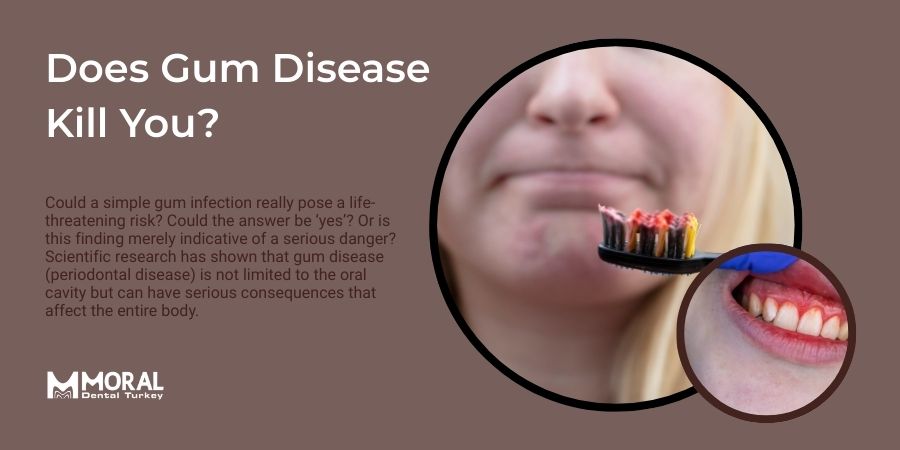
Could a simple gum infection really pose a life-threatening risk? Could the answer be 'yes'? Or is this finding merely indicative of a serious danger?
Scientific research has shown that gum disease (periodontal disease) is not limited to the oral cavity but can have serious consequences that affect the entire body.
In this article, we will discuss the effects of gum disease on systemic health, its relationship to mortality risk, and methods of prevention in light of scientific data.
How is gum disease diagnosed?
During an examination, the dentist uses the following methods:
- Assessment of gum bleeding and swelling
- Measurement of periodontal pocket depth (the space between the gum and the tooth)
- Checking for tooth mobility
- Assessment of bone loss using X-rays when necessary
What are gum diseases?
Gum diseases are, simply put, bacterial infections and inflammation of the tissues surrounding and supporting our teeth. They are often referred to as a 'silent threat' because they cause little pain in the early stages, and most people do not realize there is a problem.
Gingivitis (Gum inflammation): Early warning
This is the mildest and earliest stage of the disease. It occurs when the sticky, bacterial film layer that constantly forms in our mouths, called 'plaque,' irritates the gums.
- Your gums are redder than normal, swollen, and bleed easily, especially when brushing or flossing.
- At this stage, there is no bone or tissue loss yet. With good oral hygiene and professional teeth cleaning, the condition is completely reversible.
Periodontitis: Advanced stage
If gingivitis is not treated in time, the inflammation spreads to the deeper layers of the gums and the bone supporting the teeth. As the body's immune system fights the bacteria, both the toxins secreted by the bacteria and the body's own response begin to destroy the bone and tissues that hold the teeth in place.
The gums pull away from the teeth, creating pockets filled with infection.
If left untreated, the bone supporting the teeth is destroyed, the teeth become loose, and eventually tooth loss occurs.
What are the symptoms of gum disease?
When should you suspect it?
Even if gum disease is painless, your body may signal it with the following signs:
- Persistent bad breath.
- Teeth appearing longer than usual due to receding gums.
- Pus formation between the gums.
- Loose teeth or gaps between them.
- Sensitivity to hot or cold.
Why are gum diseases more common in some people?
Poor hygiene is not the only cause of gum disease; certain factors significantly increase the risk:
- Smoking: This is one of the biggest risk factors and makes treatment more difficult.
- Diabetes: People with diabetes are more susceptible to infections.
- Genetics: Some people are more prone to this disease no matter how well they care for their teeth.
- Hormones: Changes during periods such as pregnancy or puberty can make gums more sensitive.
Why is gum disease considered a 'silent threat'?
Gum disease (periodontal disease) is usually painless in its early stages. You may not realize you have a serious problem until your gums become red, swollen, or bleed. However, even at this stage, bacteria may have settled below the gum line and started to destroy bone tissue.
If left untreated, the infection in your mouth can turn into an open wound, and bacteria can enter your bloodstream and spread to other parts of your body. This spread is the fundamental reason why gum disease can be described as 'deadly.'
The link between gum disease and other life-threatening illnesses
Research shows that your gum health is a reflection of your overall health and is directly linked to many serious illnesses:
- Heart disease and stroke: People with gum disease are 2 to 3 times more likely to have a heart attack. Bacteria in the mouth can cause inflammation in the arteries and blood clots, which can also increase the risk of stroke.
- Diabetes: There is a two-way relationship between gum disease and diabetes. Gum inflammation makes blood sugar control difficult, while diabetes also increases the severity of gum disease. If you have diabetes and your gums bleed, your risk of death may increase by 400 to 700 percent.
- Cancer risk: A study, particularly in men, found that people with gum disease had a 62 percent increased risk of pancreatic cancer.
- Respiratory diseases: Bacteria in the mouth can be drawn into the lungs, causing diseases such as pneumonia and bronchitis or worsening existing lung problems.
- Alzheimer's and dementia: Some studies suggest that bacteria causing gum disease may reach the brain and contribute to the development of Alzheimer's disease.
Treatment options to halt disease progression/ Ways to prevent and reduce your risks
Halting the progression of gum disease and restoring your oral health is not only possible but also a vital step in protecting your overall physical health. Treatment options range from simple home care routines to advanced surgical interventions, depending on how far the disease has progressed.
Here are the basic treatment methods used to stop the progression of gum disease:
Home care and lifestyle changes
The success of gum disease treatment depends on how diligently the patient adheres to their daily care routine.
- Effective brushing and flossing: Brushing at least twice a day and using dental floss is the most effective way to remove plaque. Interdental brushes or oral irrigators such as the 'Waterpik' are highly effective at removing bacteria from areas that regular toothbrushes cannot reach.
- Quitting harmful habits: Smoking significantly reduces the chances of successful treatment; therefore, quitting smoking is considered part of the treatment.
Non-surgical professional treatments
In the early and middle stages of the disease (gingivitis and mild periodontitis), non-surgical methods are preferred to control the infection:
- Scaling and root planing: In this 'deep cleaning' procedure, tartar is scraped from below the gum line, and rough spots on the tooth root surface are smoothed to make it harder for bacteria to adhere.
- Medication: In addition to deep cleaning, local or systemic antibiotics may be prescribed to kill bacteria. Small chips or gels (containing chlorhexidine or doxycycline) that are placed in the gum pockets and release medication over time may also be used.
- Laser treatment (LANAP): In some cases, infected tissues can be cleaned using laser technologies that cause less pain and bleeding than traditional methods and do not require incisions.
Surgical Interventions
If the disease has created deep pockets and caused bone loss, surgical options come into play:
- Pocket reduction surgery (flap surgery): The gums are folded back to clean the tartar deep within the pockets, and then the gums are sutured back tightly around the tooth.
- Soft tissue and bone grafts: Tissue can be transplanted from another part of the mouth (usually the palate) to replace lost gum tissue. Bone grafts aim to rebuild lost bone using natural or synthetic bone pieces.
- Guided tissue regeneration: Special materials are used to prevent the gum tissue from growing into the bone cavity, encouraging the natural regrowth of bone and connective tissue.
Innovative approaches and maintenance therapy
- Probiotics: Studies show that predatory probiotic bacteria such as 'Bdellovibrio bacteriovorus' can reduce disease-causing bacteria in the mouth by up to 75%.
- Continuous supportive care: After successful treatment, the patient enters a lifelong 'periodontal maintenance' process. This process includes regular specialist checkups and professional cleanings.
Does gum disease really kill?
This is an important question that preoccupies many people. The short and straightforward answer is gum disease does not directly cause death, but it significantly increases the risk of death by indirectly contributing to fatal illnesses.
Therefore, although gum disease is not recorded as a direct cause of death, it is a preventable and treatable health problem that significantly increases the risk of mortality.
F.A.Q.:
Is gum treatment painful?
In modern dentistry, treatments are generally not uncomfortable. Local anesthesia is applied during deep cleaning (scaling) procedures to numb the area. There may be slight sensitivity for a few days after the procedure, but this is temporary and can be controlled with painkillers recommended by the dentist.
Is gum bleeding normal?
It is definitely not normal. Gum bleeding is not a sign of good health but rather the most important sign of inflammation. Although many people consider bleeding while brushing their teeth to be normal, it is a warning sign that should not be ignored.
Does gum disease go away completely, or does it recur?
It is not accurate to say that periodontal disease is 'completely cured.' A patient who has had periodontitis, in particular, should be on a lifelong supportive periodontal treatment (maintenance) program. The disease can be kept under control with regular check-ups and good oral hygiene.
Does gum disease treatment improve my overall health?
Yes, periodontal treatment reduces the bacterial load in the mouth, decreases inflammation, and improves systemic inflammatory markers. In diabetic patients, periodontal treatment can facilitate blood sugar control.
Is gum disease contagious?
Gum disease itself is not contagious, but the bacteria that cause the disease can be transmitted through kissing or sharing utensils. Transmission of periodontal pathogens is particularly possible among family members. However, the presence of bacteria does not necessarily mean that disease will develop; a suitable environment (poor hygiene, smoking, genetic predisposition, etc.) is required for disease development.
Can gum treatment be performed during pregnancy?
Yes, gum treatment can be performed during pregnancy and is even recommended. Pregnancy gingivitis is a common condition. However:
- The second trimester (4-6 months) is the most suitable period.
- Non-urgent procedures can be postponed until after delivery.
- Be sure to inform your dentist that you are pregnant.
- If an X-ray is necessary, protective measures will be taken.