

Can you get veneers with missing teeth?
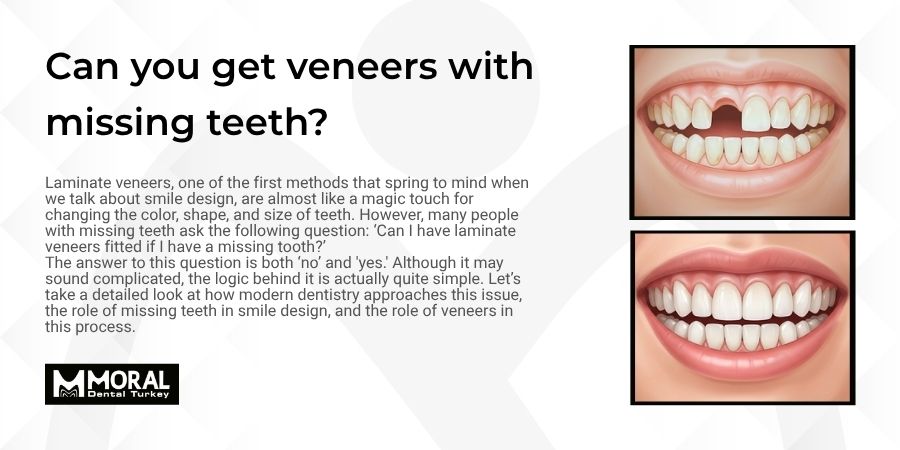
Laminate veneers, one of the first methods that spring to mind when we talk about smile design, are almost like a magic touch for changing the color, shape, and size of teeth. However, many people with missing teeth ask the following question: 'Can I have laminate veneers fitted if I have a missing tooth?'
The answer to this question is both 'no' and 'yes.' Although it may sound complicated, the logic behind it is actually quite simple. Let's take a detailed look at how modern dentistry approaches this issue, the role of missing teeth in smile design Antalya, and the role of veneers in this process.
Can porcelain veneers replace a missing tooth?
No. Porcelain veneers are not designed to replace a missing tooth on their own.
The main reason for this is the structure of veneers. Veneers are very thin shells bonded to the front surface of an existing tooth. They derive their strength and durability from bonding to the underlying healthy tooth structure. If a tooth is completely missing from your mouth, there is no foundation (tooth structure) for the veneer to bond to. Therefore, it is technically impossible to place a porcelain veneer in an empty space.
Why can't a porcelain veneer replace a missing tooth on its own?
Understanding the nature of porcelain veneers explains why they cannot replace a missing tooth. Veneers are extremely thin (usually 0.2 mm - 0.5 mm) porcelain shells that are bonded to the front surface of an existing tooth.
- Need for support: The strength of veneers comes from their bonding to the underlying healthy enamel.
- Lack of a foundation: If a tooth is completely missing, there is no 'wall' for the veneer to bond to. Therefore, it is technically impossible to simply place a veneer in an empty space.
What is the solution if a tooth is missing?
Restorative treatments should be used to fill the gaps created by missing teeth, rather than veneers. Here are the three most common options:
Dental implants:
These are artificial tooth roots placed into the jawbone. A crown is placed on top to replicate both the appearance and function of a natural tooth.
Dental bridges:
These are fixed restorations supported by the healthy teeth on either side of the gap. The adjacent teeth act as 'abutments,' and the gap in the middle is filled with an artificial tooth (pontic).
Removable partial dentures:
These are removable dentures that can be used when more than one tooth is missing.
How is smile design carried out when there is a missing tooth? (Hybrid approach)
For a patient with a missing tooth, dentists typically draw up a 'multidisciplinary' treatment plan, combining several different treatments.
Restorative treatment (filling the gap):
First, the space left by the missing tooth is filled either with an implant placed in the jawbone or with a bridge supported by the adjacent teeth.
Aesthetic harmony (Veneers):
Once the implant or bridge has been fitted, it is difficult to match the color and shape of this new artificial tooth to the adjacent natural teeth. This is where veneers come into play. By applying veneers to your other natural teeth, it ensures that all teeth are the same shade of white, the same size, and have the same texture.
Congenital missing teeth (Lateral incisor deficiency)
Some people are born without lateral incisors due to genetic factors. In such cases, dentistry offers an excellent solution:
- Canine conversion: Through orthodontic treatment, the canine teeth are moved to replace the missing lateral incisors.
- Creating an illusion: A porcelain veneer is then applied to the canine tooth to give it the shape of a 'lateral incisor.' In other words, the veneer alters the appearance of an existing tooth to aesthetically close the gap created by the missing tooth.
Pre-treatment assessment criteria
The key factors determining whether you are a suitable candidate for veneers when you have missing teeth are as follows:
Bone and gum health:
Bone density is a prerequisite if an implant or bridge is to be fitted, while healthy gums are essential if veneers are to be fitted.
Occlusion:
The way your teeth come together is crucial to prevent the porcelain from breaking.
Smile line analysis:
Using technologies such as DSD (Digital Smile Design), the harmony of the teeth with the lips and face is simulated in advance.
How does the process work?
Analysis and documentation: Photographs, videos, and digital scans are taken.
Mock-up (Prototype): Before any work is done on your teeth, a temporary design is created so you can see the finished result in your mouth. This allows you to test how your smile will look once the gap has been filled.
Application: First, the implant or bridge procedure is completed (a healing period may be required); then the veneers are fitted to the teeth
Combining implants, bridges and veneers
We've now reached the part where the answer to the question “Can I have veneers fitted if I'm missing a tooth?” is "yes." Once you've replaced your missing tooth with an implant or bridge, you can have veneers fitted to your other natural teeth to achieve a flawless and harmonious smile.
Dentists typically use this hybrid approach in the following situations:
- To ensure color matching: It is difficult to match the color of a crown placed on an implant exactly with the adjacent natural teeth. By applying veneers to the other teeth, all teeth can be made the same shade and tone.
- Creating symmetry: Veneers are an excellent tool for harmonizing the shape of the newly placed tooth with the form of the adjacent teeth.
- Comprehensive smile design: If you have one or two missing teeth and the remaining teeth are crooked, stained, or have gaps, a combination of restorative treatment (implants/bridges) and veneers can give you a 'Hollywood Smile.'
Transformation of canine teeth
Sometimes tooth loss manifests as a genetic (congenital) absence of the lateral incisors. In such cases, orthodontic treatment is used to move the canine teeth forward, and porcelain veneers are placed over them to give these teeth the appearance of 'lateral incisors.' Here, the veneer does not replace the missing tooth; rather, it resolves the aesthetic issue caused by the missing tooth by altering the appearance of an existing tooth.
Conditions that may preclude treatment
Even if you have a missing tooth, you may not always be a suitable candidate for veneers. Your dentist will assess the following factors:
- Bone and gum health: Sufficient bone density is required for implants, while healthy gums are essential for veneers.
- Teeth grinding (bruxism): The risk of porcelain fracture is very high in people who grind their teeth severely.
- Amount of enamel: For veneers to bond properly, there must be sufficient enamel, which is the outermost layer of the tooth.
What to use for missing teeth + aesthetics?
|
Clinical Situation |
Main Treatment |
How Is the Esthetic Surface Achieved? |
|
Single missing tooth (anywhere) |
Implant + Crown or 3-unit traditional bridge |
The crown or bridge is made of high-quality porcelain. It can be shaped and shaded to mimic a natural tooth or a laminate veneer, but it is technically a crown/bridge, not a veneer. |
|
Single missing tooth + healthy adjacent teeth (no crowns wanted) |
Implant + Crown or Maryland bridge (resin-bonded bridge) |
The pontic (false tooth) and the wings can be made of porcelain. The visible part looks very natural but is still a bridge, not a laminate. |
|
Multiple missing teeth (e.g., 2-3 in a row) |
Implant-supported bridge or traditional partial bridge |
The bridge is made of multilayer porcelain. The surface can be textured and glazed to look like a row of natural teeth or laminate-like aesthetics. |
|
Missing front tooth + other front teeth have shape/size/color problems |
Implant or bridge for the gap Plus Porcelain laminates (veneers) on the remaining natural teeth |
Combined approach: The crown/bridge is color-matched to the new laminates. All visible surfaces are made of porcelain for uniform smile design. |
|
Missing tooth + very tight budget / temporary solution |
Composite veneer on adjacent teeth to "shrink" the gap |
The adjacent teeth are built up with composite resin. This does NOT replace the missing tooth; it only makes the gap look smaller. Not a real restoration. |
|
All teeth missing in one jaw (full arch) |
Implant-supported fixed prosthesis (e.g., All-on-4) or removable denture |
The visible part of the prosthesis is made of porcelain or high-quality acrylic. It can be designed to look like individual laminates, but it is actually a full-arch prosthesis. |
|
Missing posterior (back) tooth + wanting anterior (front) aesthetics only |
Implant or bridge in the back + Porcelain laminates on front teeth |
Back teeth are restored for function. Front teeth get traditional laminates for smile esthetics. The two treatments are independent. |